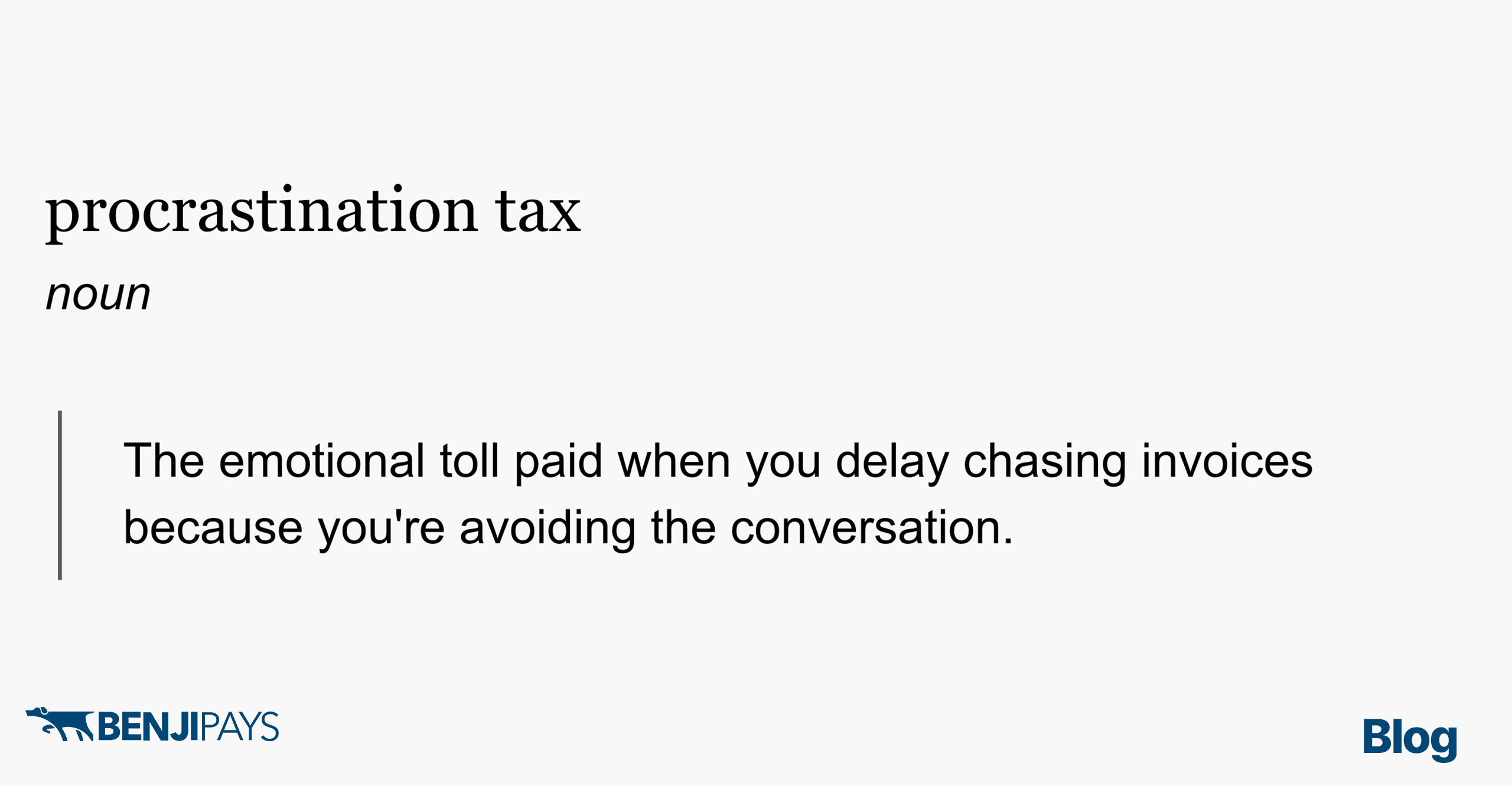
Did you ever stop to think about the emotional toll that you pay when you avoid having difficult conversations about unpaid invoices? This came up in a chat I recently had with a new Benji Pays customer.
I’d gone out on the road to a conference, one of the bigger ones in the channel. I was in the MGM Grand, which by this point I can navigate by smell alone. My room may or may not have been in an entirely different county. I do know that I hit 10,000 steps without even trying, every single day.
What’s cool about the big shows is you get to talk to a lot of people, and at this show I met up with one of our recently onboarded clients. He’d come to us six weeks earlier with a problem – he’d had something of a cash crunch, but was sitting on $150,000 in accounts receivable.
Those two things – accounts receivable and cash – they both sit on the balance sheet as assets. Liquid assets, even. But they are not the same thing. Not even a little bit, when you have payroll to meet, rent to pay, and obligations to fulfill.
After a few minutes, we got to talking about his experience with Benji Pays. He had a lot to say; he was very thankful. But you know what word jumped out to me the most?
Relief.
He said he felt relief.
In six weeks using Benji Pays, he’d chopped that $150,000 down to $40,000. To put it another way, he’d turned $110,000 in accounts receivable into $110,000 in cash. But it wasn’t the money that mattered most – it was the profound sense of relief that he felt, as founder and CEO, by way of tackling his accounts receivable problem.
It got me thinking. He’d paid the Procrastination Tax.
Business is a human endeavour. We’re all technical folks, but there’s an emotional side of all this, and that’s the Procrastination Tax.
He’d put off having the hard conversations. The Procrastination Tax is the emotional toll you pay when you avoid having uncomfortable conversations.
I get it. I mean, we all get it. Those conversations suck. Nobody likes picking up the phone and asking customers for money. Even when you bust your hump to get that money, you still don’t like asking for it.
But if you don’t collect on your outstanding invoices, it starts to affect your business.
Let it go on too long and it starts to affect your mental health, because of how it’s affecting your business.
The Procrastination Tax is a human toll. And you pay it when you avoid having hard conversations with your clients about money. Don’t get me wrong. He still had to have $40,000 worth of hard conversations. But he would now be coming from a balanced place. Those conversations are a lot easier when they’re not existential, when those awkward talks don’t carry the weight of your entire company.
There’s other ways the Procrastination Tax shows up, too. Sometimes it’s that investment you put off because it seemed too risky given your financial position at the time. Other times it’s that vacation you didn’t take because you pushed out a hiring decision by a quarter, thinking it would save a few bucks.
But all of those things, they do add up. They do take a toll. Sometimes the quest for outstanding financial performance isn’t about running the world’s greatest business. It can be, don’t get me wrong. But sometimes, it’s just about your own mental well-being.
If your finances are in great shape, you’re going to feel better.
One thing I’ll say about the Procrastination Tax – it’s a tax you don’t have to pay. In fact, it’s a tax you impose upon yourself. Nobody, and I do mean nobody, should be paying any more taxes than they absolutely have to.
So do yourself a favour, and think about the Procrastination Tax for a minute. How would you feel if you cut your accounts receivable down? Significantly. In a matter of weeks.
Let Benji Pays have the difficult conversations for you. I bet you’ll feel relief, too.